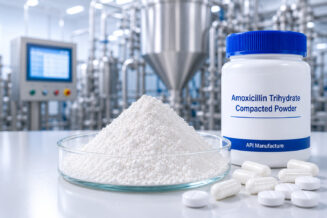
From Molecule to Medicine: The Industrial Story of Famotidine API
Every pharmaceutical product begins long before it reaches the patient. Behind every tablet, capsule, oral suspension, or injectable product lies a complex process involving pharmaceutical research, raw material selection, chemical manufacturing, quality control, formulation development, and regulatory compliance. Famotidine API is a good example of how these different stages come together to transform a chemical compound into a reliable pharmaceutical product.
Understanding the Molecule
Famotidine belongs to the histamine H2-receptor antagonist class and is used to reduce gastric acid secretion. Its therapeutic activity is the starting point, but pharmaceutical manufacturers must also understand the physical and chemical properties of the active pharmaceutical ingredient (API).
During development and manufacturing, factors such as chemical stability, purity, impurity profile, particle characteristics, and moisture sensitivity can influence how the API performs during formulation and production. Understanding these properties helps manufacturers establish appropriate specifications and develop processes that consistently produce pharmaceutical-grade material.
From Raw Materials to Pharmaceutical-Grade API
The production of pharmaceutical-grade Famotidine requires carefully controlled manufacturing processes and rigorous quality standards. The selection and control of starting materials are particularly important because variations in raw materials can affect the quality of the final API.
Key quality considerations include:
-
Chemical purity and impurity profile
-
Consistency of physical properties
-
Particle size distribution
-
Moisture content
-
Stability under defined storage conditions
-
Compliance with applicable pharmacopeial and regulatory requirements
Quality control is applied throughout the manufacturing process rather than only at the final stage. Analytical testing and process monitoring help ensure that each batch meets established specifications.
From API to Finished Dosage Form
Transforming Famotidine API into a finished pharmaceutical product involves much more than simply combining the active ingredient with excipients. Formulation scientists must evaluate how the API interacts with other components and how its physical properties affect manufacturing and product performance.
For example, excipient compatibility is important because interactions between the API and excipients can influence stability or other product characteristics. Powder properties, including flow and handling behavior, can also affect manufacturing efficiency, particularly during processes such as blending and compression.
Environmental conditions are another consideration. Temperature and humidity can influence material stability and manufacturing performance, making appropriate storage and process controls essential.
Famotidine may be formulated into dosage forms such as tablets and oral suspensions, while specific products and markets may have additional formulation requirements. Combination products may also require careful evaluation of the compatibility and performance of multiple active ingredients.
Industrial Manufacturing Considerations
At commercial scale, pharmaceutical manufacturing depends on reproducibility. A process that performs well at laboratory scale must be capable of producing consistent results across larger batches.
Manufacturers therefore focus on several areas, including:
-
Batch-to-batch consistency
-
Process control and optimization
-
Quality assurance
-
Analytical testing
-
Efficient production
-
Documentation and traceability
-
Compliance with regulatory requirements
Even relatively small changes in API properties can affect downstream processing. For this reason, strong communication between API manufacturers, formulators, quality teams, and regulatory functions is essential.
Looking Ahead
The pharmaceutical industry continues to develop more efficient manufacturing technologies and advanced formulation approaches. Areas such as improved drug-delivery systems, modified-release formulations, process analytical technologies, and patient-focused dosage forms continue to shape pharmaceutical development.
For established molecules such as Famotidine, these developments can support improvements in manufacturing efficiency, product quality, and formulation performance.
The Bigger Picture
The industrial journey of Famotidine API illustrates the connection between chemistry, pharmaceutical science, engineering, and quality management. From the selection of starting materials and control of impurities to formulation development and commercial-scale production, every stage contributes to the quality of the final medicine.
Ultimately, producing a reliable pharmaceutical product is not simply a matter of manufacturing a molecule. It requires a controlled and integrated process in which scientific understanding, manufacturing precision, quality systems, and regulatory standards work together to transform an